OUR MISSION
Vesta Educations mission is to provide specialist, evidence-based provision for young people with EBSA, those in EOTAS arrangements, and EHE families — enabling every young person to achieve their potential academically, socially, and personally, in genuine partnership with the schools, local authorities, and families who support them.
At the heart of our offer is high-quality English and Maths teaching, delivered by qualified and experienced staff, with a clear focus on securing Grade 4+ at GCSE and Functional Skills qualifications where appropriate. We know that qualifications change lives — and we hold high expectations for every young person we work with, however long they have been out of education.
Our integrated model brings together an onsite therapist, a specialist SEN teacher and assessor, and a Level 6 careers lead who curates robust, personalised post-16 pathways — including off-site experiences and visits from industry experts — actively supporting a reduction in NEET outcomes. Where a return to mainstream education is the goal, we support reintegration actively and collaboratively. Where the pathway leads elsewhere, we ensure young people arrive there equipped, qualified, and confident.
WHAT WE OFFER

-
High-quality GCSE and Functional Skills teaching by qualified, experienced specialists — from Entry Level through to Grade 4+ and beyond. Every student has a clear qualification pathway agreed with their family and, where applicable, their school or local authority.
-
A qualified therapist is embedded within the provision, not bolted on. For EBSA students and those with complex needs and trauma, therapeutic support is woven into the school day — building emotional regulation, resilience, and readiness to learn.
-
On-site specialist assessment for Access Arrangements, dyslexia screening and formal dyslexia assessment — ensuring that every young persons needs are identified, understood, and met. Students receive the AA assessments, screening and support they need as part of their provision.
-
A dedicated careers lead — qualified to Level 6 — designs personalised post-16 pathways for every student. This includes off-site visits, visiting industry experts, and structured planning for further education, apprenticeships, and employment, actively supporting a reduction in NEET outcomes.
-
Our AQA Unit Award-accredited complementary curriculum — mindfulness and meditation, art and photography, horticulture, outdoor learning — is designed to rebuild confidence and emotional regulation alongside academic progress. For EBSA learners in particular, re-engaging with the experience of learning itself is often where progress begins
-
We offer small-group and one-to-one tuition after core hours, available to Vesta students, EHE families, and young people in mainstream schools who need additional support. This extends Vestas capacity to support young people beyond our core provision.
-
We offer flexible EOTAS packages designed to meet local authority Section 19 duties — part-time and blended arrangements tailored to the individual young persons needs profile and agreed outcomes.
-
For young people whose goal is a return to mainstream school, we provide a structured, planned reintegration pathway — working closely with the receiving school, the young person, and their family throughout.
OUR VALUES
Vesta’s values are not aspirational statements. They are the principles that shape every decision, every session, and every relationship — with young people, families, and the professionals we work alongside.
-
Emotional safety is the prerequisite for learning. For EBSA students in particular, this sequencing is non-negotiable — and everything else at Vesta follows from it.
-
Trust is established before expectations are introduced. For young people whose previous educational experiences have been characterised by anxiety or repeated difficulty, this is the only model that works.
-
Every young person at Vesta — whether EBSA, EOTAS, or EHE — is capable of meaningful progress and genuine achievement. We hold high expectations while being responsive to pace and readiness. Our goal is always qualifications and futures.
-
Academic progress sits alongside emotional, social, and familial wellbeing. Our integrated model — therapist, SEN assessor, careers lead, and teaching team — means that all the support a young person needs is in one place, working together.
-
Every young person at Vesta is known: by name, by history, by what they find difficult and what they are good at. For many of our students — particularly those with care experience — being genuinely known by a consistent, skilled adult is a new and transformative experience.
-
The young person in front of us comes before the data point, the referral form, or the funding band. This is the Vesta promise.
WHO WE SERVE
Understanding EBSA — and the Young People Who Need Us Most
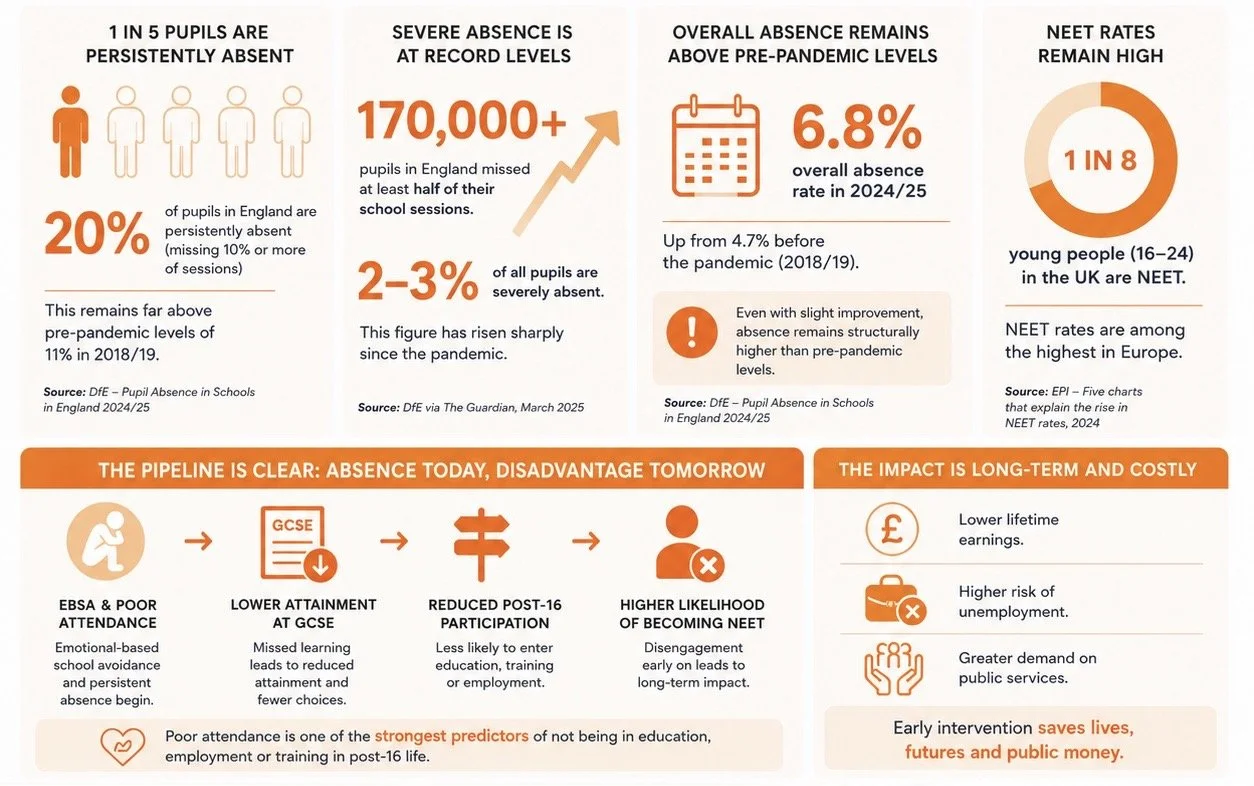
Emotionally Based School Avoidance is a recognised and complex presentation in which young people are psychologically unable to attend school, typically due to anxiety, trauma, unmet SEND needs, or a history of adverse experiences in educational settings. It is distinct from deliberate non-attendance, and it requires a distinct response. The scale of need is significant and growing. Schools and local authorities are working hard to respond — but the nature of EBSA means that for some young people, specialist provision is an essential part of the solution. The same is true for many EOTAS students and EHE families, who need structured, high-quality provision that can flex to their young persons needs.
Who is most likely to need specialist EBSA and EOTAS provision?
Research and our own community evidence consistently identifies three groups as disproportionately affected:
Care-experienced Young People
We have particular expertise in supporting children with care experience — giving them the consistency, safety, and high expectations they deserve. Young people in care and care leavers are significantly more likely to experience EBSA and to be placed in EOTAS arrangements. Our relational model is well-suited to this group, and we work in close liaison with Virtual School Heads and social care teams throughout every placement.
Neurodivergent Young People
At Vesta, we are highly adaptive to students with ASD, ADHD, SEMH needs, dyslexia, PDA profiles, and sensory processing differences. Neurodivergent students are among those most frequently represented in EBSA and EOTAS cohorts. Vesta’s provision is designed with neurodivergent young people in mind at every level: small, predictable groups; sensory-aware environments; flexible entry points; and staff trained in neurodivergent-affirming practice. Our onsite SEN assessor ensures needs are formally identified and appropriately supported.
Young People at Risk of NEET
Unaddressed EBSA is one of the most consistent pathways to NEET status. Our Level 6 careers lead works with every student on a personalised post-16 plan — incorporating off-site experiences, visiting industry experts, and structured destination planning. Combined with accredited qualifications and therapeutic support, this means young people leaving Vesta are genuinely ready for what comes next.